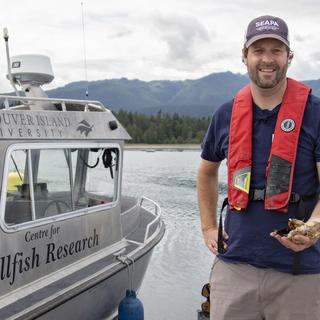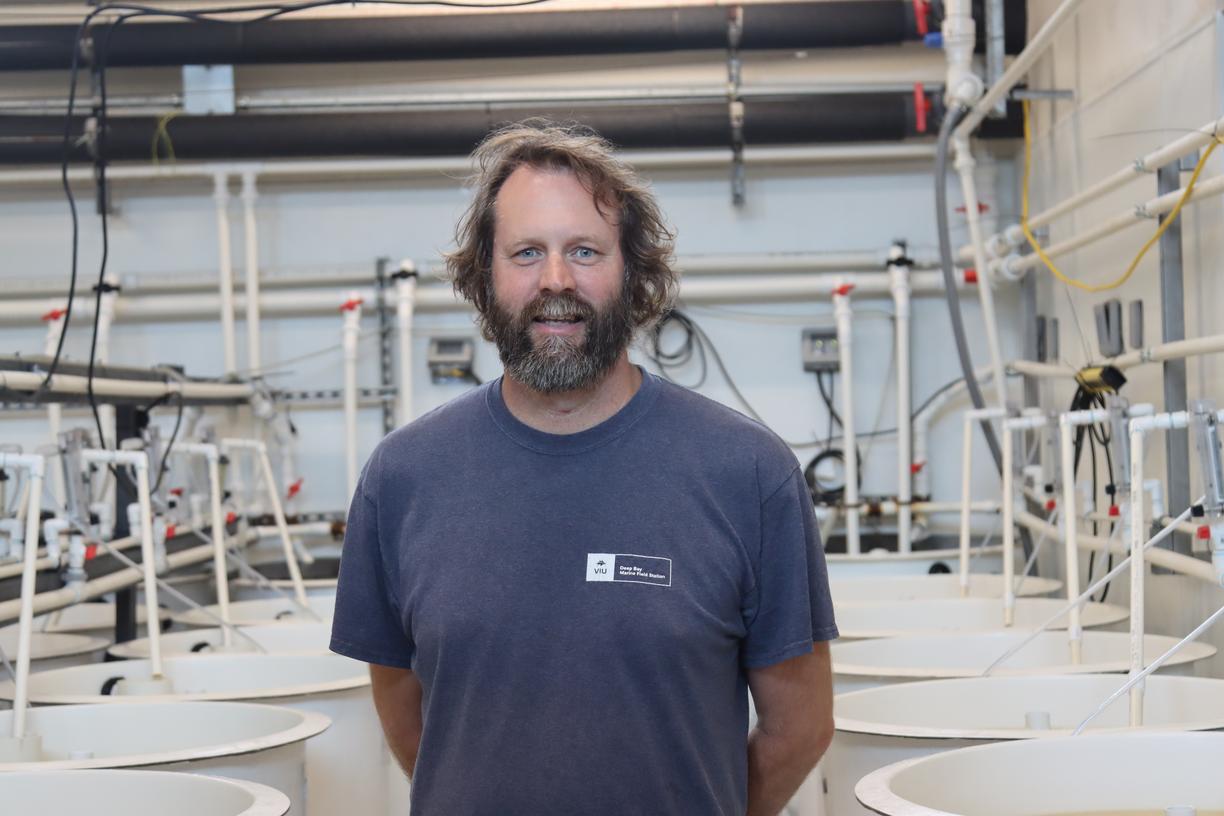
Dr. Tim Green, VIU’s Canada Research Chair in Shellfish Health and Genomics is studying how to help shellfish adapt to climate change while keeping them safe for human consumption.
Dr. Tim Green is future-proofing BC’s shellfish industry with the help of a Natural Sciences and Engineering Research Council of Canada Discovery Grant.
Helping shellfish survive climate change while keeping them safe for humans to eat is the focus of a new research project at Vancouver Island University (VIU).
Dr. Tim Green, VIU’s Canada Research Chair Shellfish Health and Genomics and Director of the Centre for Shellfish Research, is leading the project.
“We’re trying to understand how shellfish will adapt to climate change,” said Green. “We know that our oceans are warming and as they become more acidic, they’re losing oxygen. This is a really stressful situation for marine life.”
Green and his team have already developed shellfish that are better able to handle some environmental stressors. The next step is understanding whether those same traits affect other important factors, including disease resistance and seafood safety.
“You can make an oyster resistant to ocean acidification,” he said. “But does that then make it more susceptible to disease because it’s allocating more resources to growth and less emphasis on its immune system?”
Climate change is also changing how bacteria and other pathogens affect shellfish, he added. Some of these pathogens can make people sick if they eat contaminated seafood.
“It’s great to make shellfish that can survive, but not if they don’t make it to market because they’re contaminated,” Green said.
Green’s five-year project is supported by a Natural Sciences and Engineering Research Council of Canada Discovery Grant.
Green’s research is housed at VIU's Deep Bay Marine Field Station, which has a federally licensed shellfish hatchery and farm.
“We have what we call a pedigree or family-based breeding program,” says Green. “We carry lots and lots of different lines of shellfish. Each tank is a single mom and dad.”
The team measures traits such as growth, survival and shell colour to identify the best shellfish for future breeding. They will also use DNA tools to better understand which traits help shellfish survive.
The project includes partnerships with First Nations communities to study seafood safety as ocean conditions change.
“First Nations have lots of traditional ecological knowledge around how to harvest shellfish and eat them safely. They’ve been doing it for 14,000 years,” Green said. “But as climate starts to change, the kinds of pathogens that we have and toxins that we have in our water is rapidly changing.”
A key goal is to develop tools, such as rapid test kits, that could help coastal communities know when shellfish are safe to harvest and eat, improving food security and autonomy, said Green.
The research could also help strengthen British Columbia’s shellfish industry by improving survival rates. Green said when he arrived at VIU in 2018, some growers were losing up to 95% of their shellfish.
“If we can improve mortality, we could have millions of extra dollars in the BC economy,” he said.
-30-
Media contact:
Eric Zimmer, Communications Officer, Vancouver Island University
P: 250.618.7296 | E: Eric.Zimmer@viu.ca | W: news.viu.ca
The VIU community acknowledges and thanks the Snuneymuxw, Quw’utsun, Tla’amin, Snaw-naw-as and Qualicum First Nation on whose traditional lands we teach, learn, research, live and share knowledge.
Related Posts