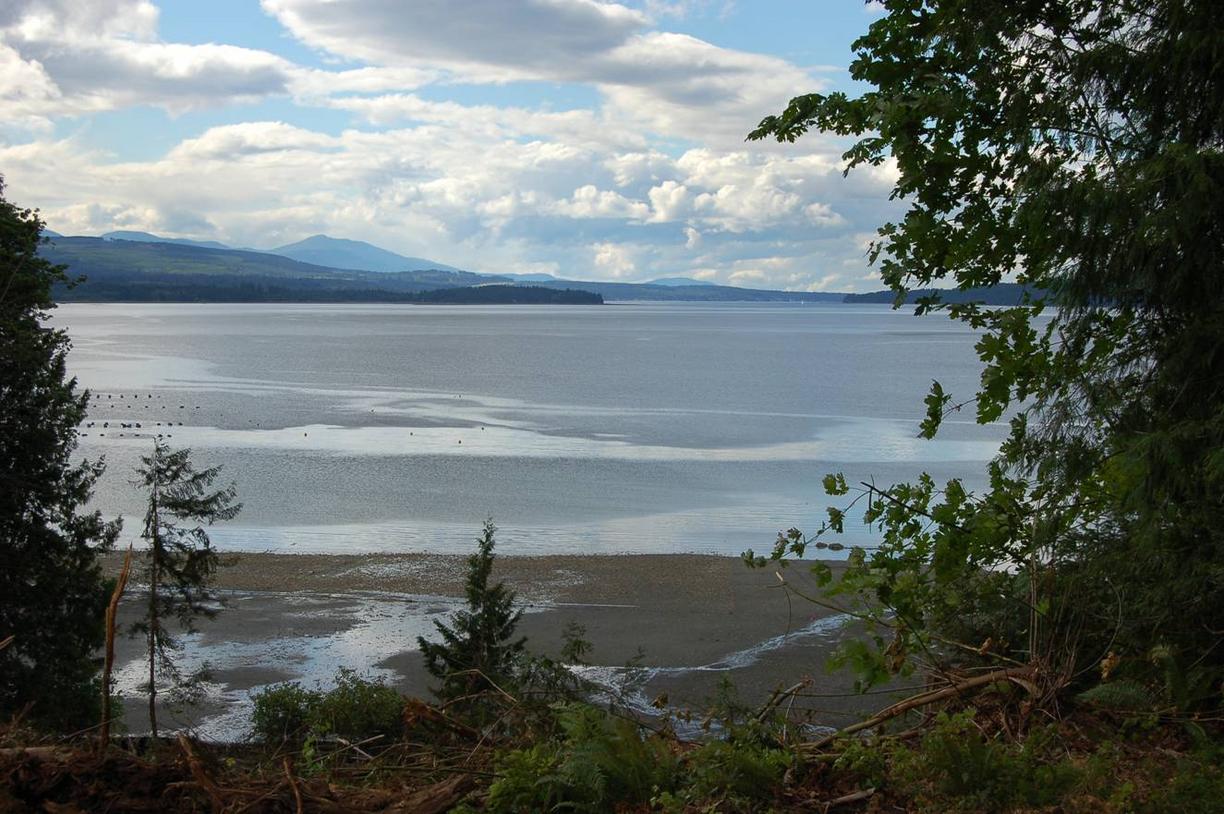
A view of Baynes Sound
Photo: Vancouver Island University
What: Baynes Sound – Signs of Life, Signs of Change project public launch event open house
When: Thursday, June 25, 2 to 5 pm
Where: Deep Bay Marine Field Station, 370 Crome Point Road, Bowser, BC
Cost: Free (admission by donation)
Vancouver Island University’s (VIU’s) Deep Bay Marine Field Station is making marine research in Baynes Sound more accessible to the public.
The research station is hosting an open house on Thursday, June 25 to launch the Baynes Sound – Signs of Life, Signs of Change project. Baynes Sound is a 40-kilometre stretch of sea between Vancouver Island and Denman Island that is designated as an ecologically and biologically significant area.
The open house will showcase the results of the year-long education project, which highlights research happening in Baynes Sound ranging from water quality monitoring, to making shellfish more resilient to rising ocean temperatures, to kelp forest restoration.
“The goal of the project is to increase accessibility to this research and not have the science hidden behind a veil,” said Marnie Branfireun, Public Education Coordinator. “It’s about opening up the doors of academia and engaging people’s curiosity.”
The open house features an interactive 3D Baynes Sound model, presentations by researchers, a kiosk with a live Ocean Networks Canada data feed, educational program demonstrations, and a virtual tour of the shoreline signage trail that travellers along Baynes Sound will see.
The Baynes Sound – Signs of Life, Signs of Change website includes eight marine research themes: ocean acidification, oyster aquaculture, marine biodiversity, water quality monitoring, coastal development and pollution, whale populations, herring spawn and kelp forest restoration.
Supported through the national Marine Environmental Observation, Prediction and Response Network (MEOPAR) network, the project brought together VIU students, staff and researchers as well as community partners including the BC Shellfish Growers Association, Fisheries and Oceans Canada, the Qualicum First Nation, and Ocean Networks Canada. MEOPAR receives funding from the federal government’s Strategic Science Fund to support leading-edge research, overcome barriers to collaborative research and train the next generation of marine professionals.
The Baynes Sound project builds on the role of Deep Bay as a hub for research and education, creating new ways for visitors to connect with the science happening along the coast.
“People don’t see most marine research because it’s happening out on the water or underwater,” said Branfireun. “This project takes people into that environment.”
To learn more about the project, visit the Baynes Sound – Signs of Life, Signs of Change homepage.
-30-
Media contact:
Eric Zimmer, Communications Officer, Vancouver Island University
P: 250.618.7296 | E: Eric.Zimmer@viu.ca | W: news.viu.ca
The VIU community acknowledges and thanks the Snuneymuxw, Quw’utsun, Tla’amin, Snaw-naw-as and Qualicum First Nation on whose traditional lands we teach, learn, research, live and share knowledge.
Related Posts