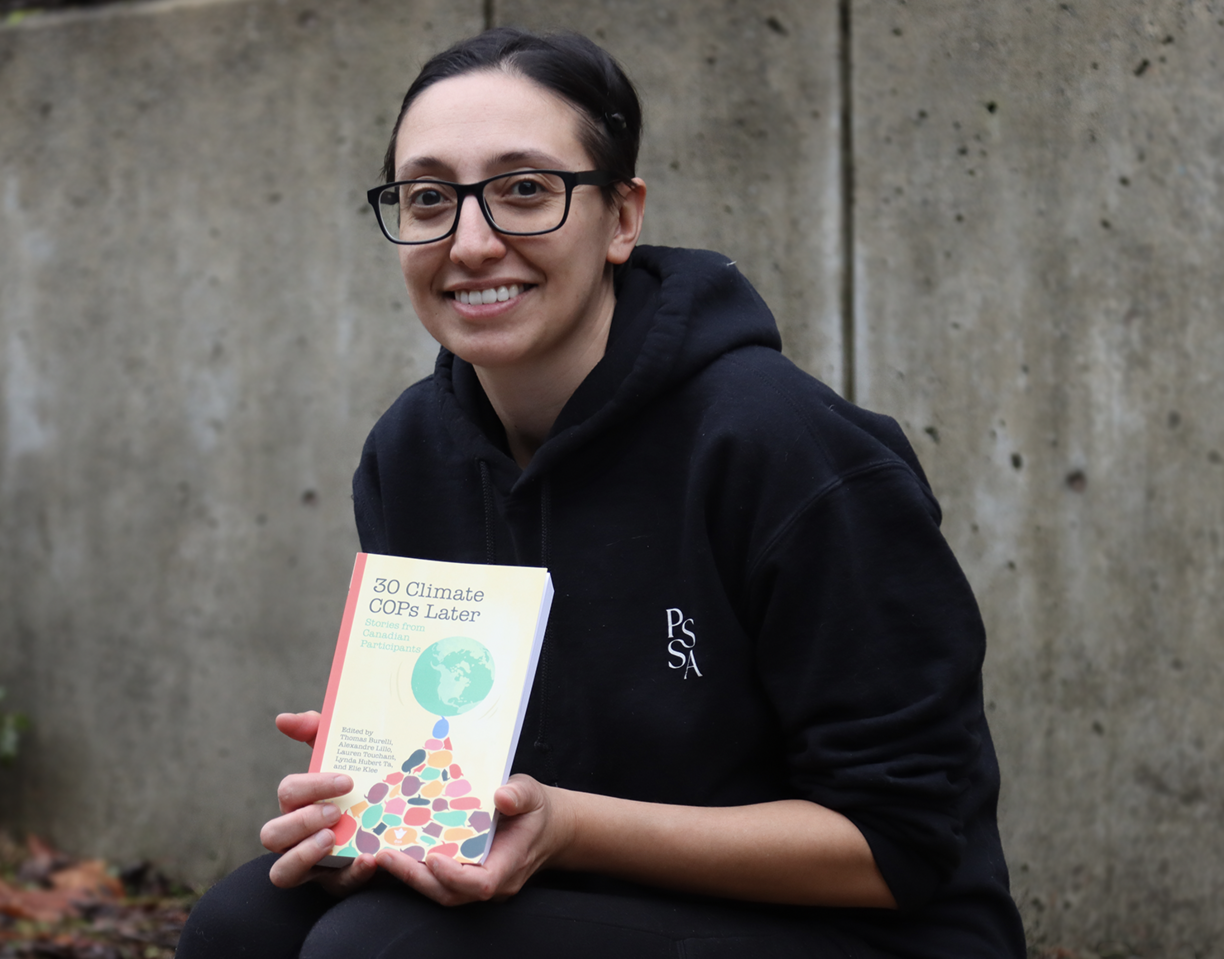
VIU Political Studies Professor and regular COP attendee Dr. Lauren Touchant holds a copy of the book.
Photo: Vancouver Island University
Dr. Lauren Touchant co-edits book analyzing impact of conferences
Since the first annual meeting 30 years ago, the United Nations Climate Change Conferences (COPs) have guided how the world responds to climate change. These meetings bring together leaders, scientists, activists and policymakers to make decisions about the planet’s future.
This year’s event, which took place in mid-November in Belém, Brazil, also marked the release of a new book, 30 Climate COPs Later, which looks back at three decades of climate talks to ask an important question: Have these conferences truly made a difference?
Through stories from Canadian diplomats, scientists, NGO leaders, journalists and policymakers, the book offers an inside view of major successes, failures and turning points in global climate negotiations.
Among the group of editors involved in the book was VIU Political Studies Professor and regular COP attendee Dr. Lauren Touchant. She not only co-edited the book, but also contributed to three of the chapters. We caught up with her to learn a little more about her work, the book and her involvement with COP.
What motivated you to get involved in this project?
This book originated from our trip to COP 27 in Glasgow. It aims to assesses 30 years of climate negotiations, marking the 15th anniversary of the Paris Agreement. We also wanted to make COP more accessible to Canadians, explaining its significance and the crucial role of international negotiations in achieving global climate goals.
How long have you been attending COP?
I have attended COPs for five years, both online and in person, participating in conferences on climate as well as biodiversity.
What have you learned from attending these meetings?
What was most valuable was listening and learning from different actors, colleagues and initiatives, and understanding the power dynamics and the mobilization of civil society. Being able to bring these insights back to the classroom is both unique and highly valuable for students who aspire to careers in public administration or environmental and energy policy.
Can you tell us more about the story the book is telling?
The book highlights the importance of multilateralism in addressing transnational challenges such as climate change. It also explores how Indigenous peoples have increasingly participated in international climate governance, while emphasizing the challenges they often face when operating under the banner of the state. The book demonstrates that effective mitigation and adaptation to climate change require the involvement of local actors, including Indigenous communities and municipalities. These communities bear the greatest impacts of climate change, yet they have long been excluded from key conversations. Additionally, the book traces Canada’s negotiation history, providing insights into how the Canadian government has, at times, sidestepped or redirected the course of negotiations.
If there’s one thing you want people to take away after reading the book, what would it be?
Civil society must trust climate science and act decisively. Disinformation campaigns benefit only a few, while jeopardizing the future of coming generations and the most vulnerable – those already facing the harshest impacts of climate change. Civil society has the power to counterbalance corporate interests, including those of the fossil fuel industry.
What’s next for COPs in your opinion?
Important discussions lie ahead. The clash between states seeking to phase out fossil fuels and those resisting change will continue. Further dialogue is needed on developed countries’ contributions to loss and damage, as well as adaptation strategies. We observed developed nations being non-committal in Belém. In addition, more conversation around a “just transition” (pivoting to a net-zero future in a fair and inclusive way) and the role of carbon sinks (commitments to end deforestation) will be essential.
What’s your next project?
VIU alum Leah Vaisanen and I are working on two books: one on the 10-year legacy of the TRC Truth and Reconciliation Commissions, and the other on the 10-year impact of the Inquiry into Missing and Murdered Indigenous Women, Girls, and Two-Spirit People.
Related Posts