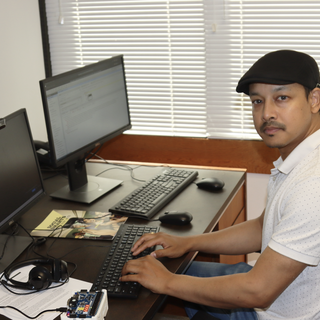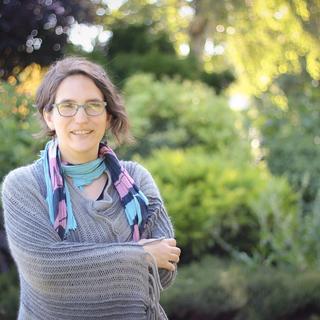
Dr. Daniel Westlake is working with the Network of Jarislowsky Chairs in Trust and Political Leadership
Vancouver Island University has a new democracy expert. Dr. Daniel Westlake is a Senior Research Fellow with the Network of Jarislowsky Chairs in Trust and Political Leadership.
Before joining VIU, he held assistant professor positions in Simon Fraser University's School of Public Policy and the University of Saskatchewan’s department of political studies. Daniel's research focuses on diversity in democratic representation and leadership, multiculturalism and immigration policy, and Canadian party competition.
His work has been published in outlets such as the Canadian Journal of Political Science, the Journal of Ethnic and Migration Studies and Party Politics. His 2020 article: “Following the Right: Left and Right Parties’ Influence Over Multiculturalism” won the 2021 John McMenemy Prize for best article in the 2020 Canadian Journal of Political Science. His 2025 article co-authored with Larry Savage and Jonah Butovsky, “The Labour Vote Revisited: Impact of Union Type and Demographics on Electoral Behaviour in Canadian Federal Politics” was short-listed for the same prize in 2026.
At VIU, Westlake is working with Dr. Michael MacKenzie, the university’s Jarislowsky Chair in Trust and Political Leadership. Together, the researchers will examine representation and political leadership in Canadian democracy, as well as political leadership education.
Your research centres on diversity in democratic leadership and representation. What motivated you to focus your efforts and attention on this area and why is it important?
My interest in diversity and representation came out of broader work I was doing on multiculturalism and immigration policy and on political parties. I started my research working on the way party positions on multiculturalism affected policy adoption. But it’s one thing to look at whether parties are advocating for particular policies, it is another thing for parties to ensure that there are diverse perspectives present in legislatures and involved in the policy process. The inclusion of people from diverse backgrounds in legislators and in other decision-making bodies is also an important test of our democracy. Who gets elected to office tells us a lot about who has access to political power and decision-making. The more those in elected office reflect the diversity of society, the better our democracy will be at adopting policies and making decisions that reflect the needs and interests of our society as a whole.
What will you focus on in your role as a Senior Research Fellow?
Michael and I are focusing research on three areas.
First, we will continue a project with VIU Education Professor Dr. Paula Waatainen. The project examines the knowledge, skills and dispositions needed by politicians in elected office. This is a project that builds on the Institute for Future Legislatures program that VIU professors ran this summer in partnership with UBC professors. The program teaches aspiring politicians about what it takes to become a legislator. One of the remarkable things that comes up whenever we run the program is that personal relationships really matter in politics. This includes between representatives and constituents and between different representatives. To do well in politics one needs the support of others. That tends not to be forthcoming to politicians that treat others poorly.
Second, Michael and I are looking at local candidates and representation to see how experience running in elections affects candidate performance and examining who runs in multiple elections. I’m working off a dataset of federal candidates that runs from 1993 to 2025. I think our work in this area will have important implications for the two elections happening this October. What I’ve been able to do so far is show that candidates who have higher vote shares relative to what one would expect from an average candidate in their riding in one election tend to also have vote shares that are higher than one would expect in the next election. Candidates who have experience running in the past tend to have higher vote shares relative to what would expect for a candidate from their party in their riding. My broad takeaway from this, and where I want to take the research, is that candidate retention matters. We focus a lot when we look at who runs for office on who parties recruit and who puts themselves forward, but I don't think we look enough at what parties do to keep candidates, especially candidates in politics. As this research develops, I would like to look more at who runs again (especially after losing the first time) and what parties do to keep good candidates in politics.
Finally, we will be doing some work on anti-democratic attitudes in Canada, building off a growing literature in the United States on the subject. We know that people in Canada tend to express fairly high levels of satisfaction with Canadian democracy. But we want to probe some of the underlying attitudes that we see as important to democracies functioning well. These include the level of hostility towards people who hold different partisan or ideological sympathies, how far Canadians think it is acceptable for their party to go in trying to get their way on issues or block an opponent, and the degree to which individuals are open to the idea that those with a different partisan or ideological sympathy have good ideas and legitimate points to make about politics.
Related Posts