How city-building, growth levels and decision-making could shape the city 60 years from now
How will Nanaimo evolve in the coming decades and what could the city look like decades down the road?
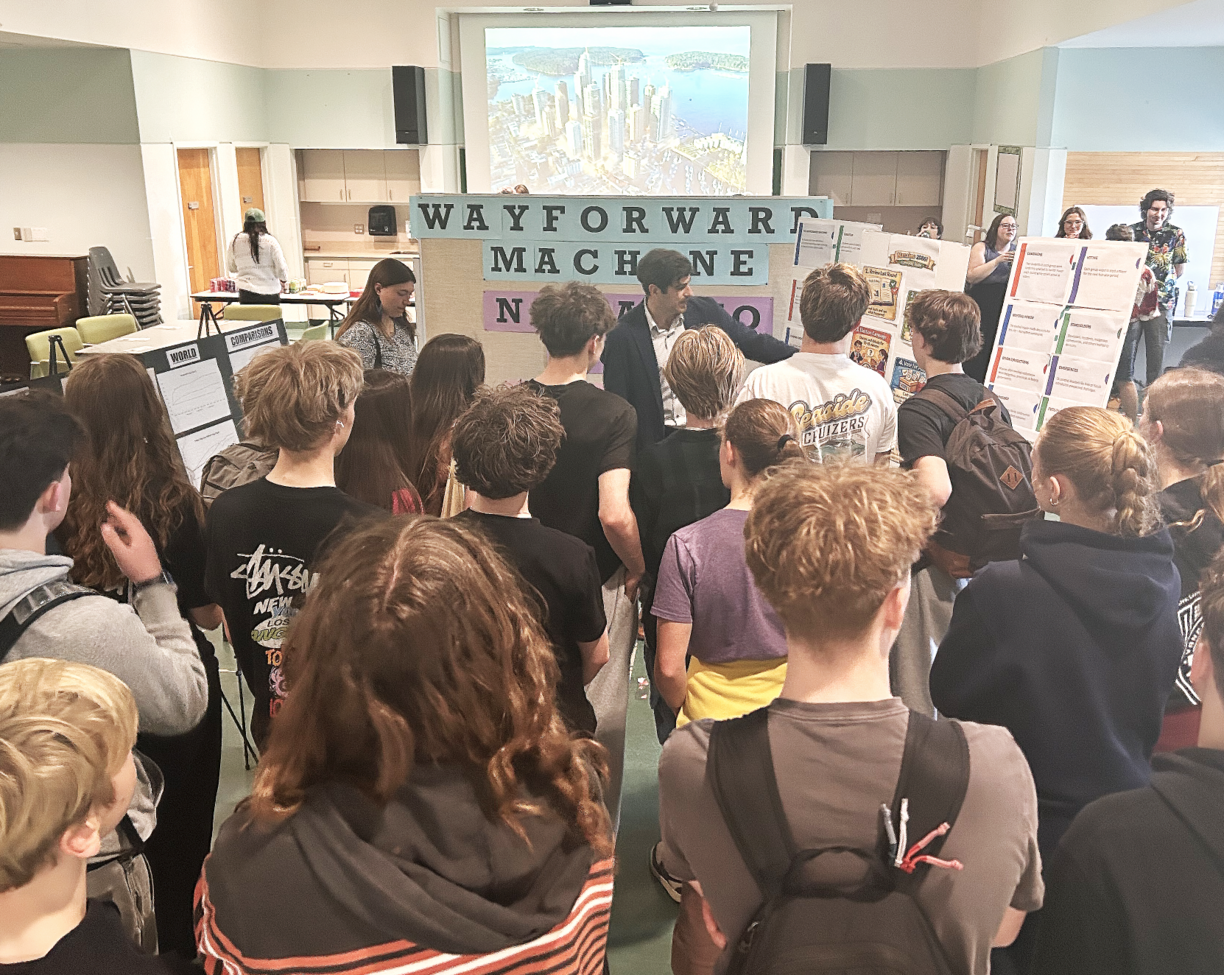
That was the question a group of Political Studies students at VIU sought to answer recently during the Futures Fair. It was the end result of a semester-long project that blended city planning, politics and simulation-based learning.
Political Studies Professor and Jarislowsky Chair in Trust and Political Leadership Dr. Michael MacKenzie led the exercise. He asked students in his class to think 60 years into the future.
“We decided to model city planning up to 2086. Students started with the same city and made different planning decisions to see how it would evolve,” he said.
Students worked on three different scenarios: World A, World B and World C. Each started with the same AI-generated city and baseline data on population, transit use and infrastructure. From there, each group made planning decisions that shaped how their city developed over time. The simulation ran through about 15 election cycles, all built into regular class time.
The Futures Fair showed how policy decisions shaped the city in different ways. Photos, charts and written analyses showed how each “world” evolved. The analysis looked at factors like population growth, livability, sustainability and identity.
World A prioritized rapid growth and expansion, achieving strong economic development. This came at the cost of rising property taxes and increasing debt. The result: long-term financial pressure, highlighting the risks of aggressive growth strategies.
World B kept growth steady and controlled debt levels, reflecting a balance between caution and development.
World C focused on keeping debt increases low and responding carefully to financial changes. This approach limited their ability to expand their tax base.
Students acted as voters, candidates, and mayors. They learned about navigating stakeholders, Indigenous communities and other levels of government.
Each class, each “world” would have an election campaign, debate their ideas and then vote. Those decisions would shape the next four years in the simulation.
“Students ran as candidates, pitched ideas and debated how their city should grow before the class voted for a mayor," Michael says.
Participating student Nikki Hearns says the Futures Fair was a “fascinating” experiment.
“Using AI to help develop Nanaimo toward a future we believed would be vital or important for people we haven’t met yet felt, on one hand, intuitive and, on the other, daunting,” she says.
As students stepped into roles as voters, candidates and mayors, they learned their vision alone was not enough.
“Each person had a strategy of their own, often influenced by the ‘voters’ (our teammates),” Nikki says. “It’s not just about great ideas. It’s about convincing others that an idea is important and will impact the future, while simultaneously ensuring that our current selves are also served.”
Even holding office came with limits.
“If you were voted mayor, you controlled the board – kind of,” she explains. “AI often pushed back on some of our instructions, reminding us that stakeholders have tremendous power and that everything costs money.”
One of the most interesting parts of the project for Michael was watching how time unfolded inside the simulation. Some students experienced many “generations” of leadership.
“We even tracked some students as mayors over time, seeing them go from their 20s to their 80s in the simulation,” he says.
The Futures Fair gave students a chance to see and reflect on how complex real-world city building can be.
“They stayed engaged the whole time,” says Michael. “It was fun right to the end.”
Related Posts