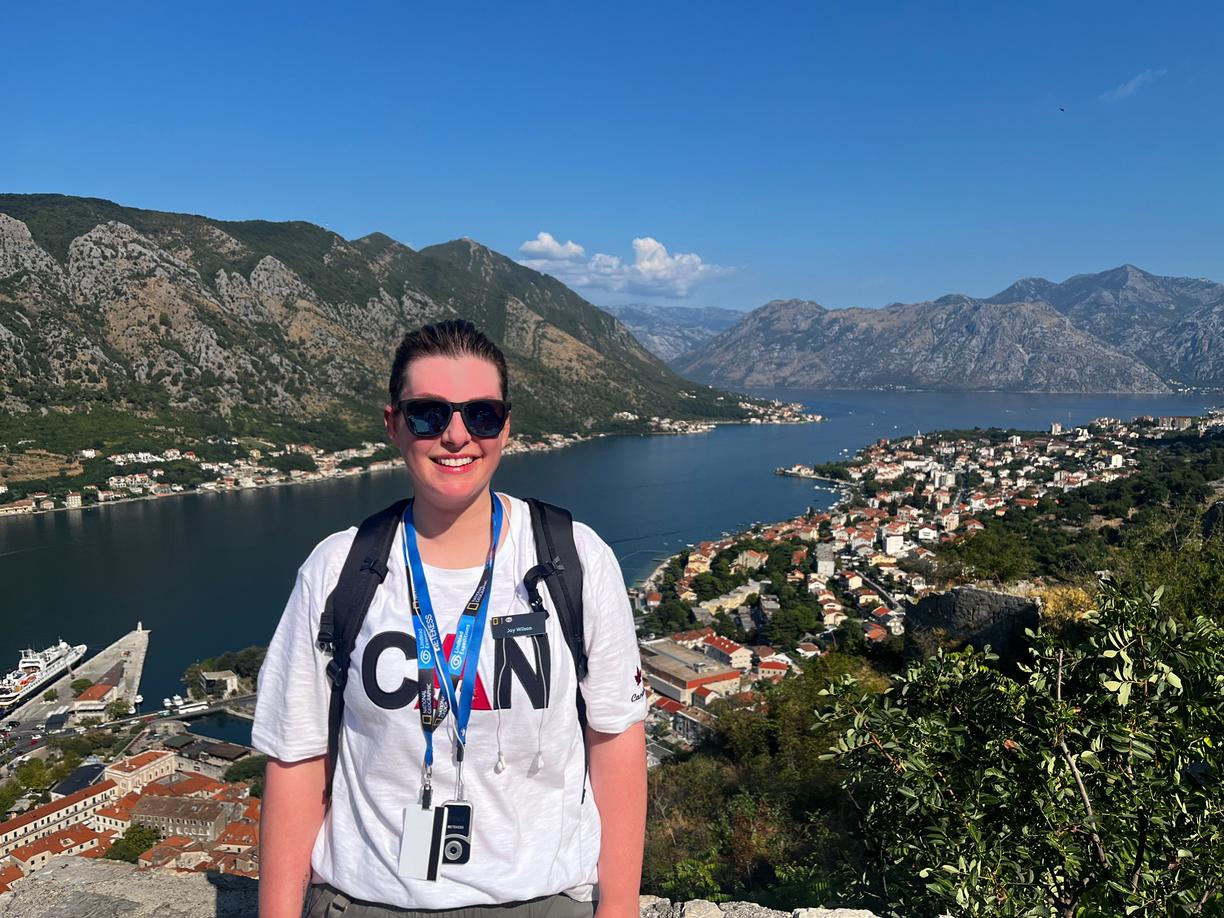
Joy Wilson poses at the top of the great Kotor City Walls in Kotor, Montenegro. "In total 2,700 stairs in blistering heat, but I made it!" she says.
Exploring her passion for global education
Joy Wilson’s path is evidence of the many places a teaching career can take you.
Over the past 15 years, she has taught in Northern Saskatchewan, Shanghai, China, and now in the Cowichan Valley School District. She was recently selected as a Grosvenor Teacher Fellow with National Geographic and Lindblad Expeditions – one of only three Canadian teachers chosen from a pool of 350 applicants. Last summer, she went on an expedition along the Dalmatian Coast, exploring Croatia and Montenegro. She is bringing her experiences into her classroom to inspire students about the world and their place in it.
“This journey has truly reinforced my passion for global education and for helping students see the world as a classroom without walls,” she says.
Joy received four degrees from VIU, including a Bachelor of Arts, Diploma of Physical Education, Bachelor of Education and, earlier this year, her Master of Education in Educational Leadership. She shares more about how her experiences at VIU have shaped her as a teacher.
What was your first job after graduation?
Teaching a Grade 8/9 classroom in Green Lake, Saskatchewan, through the Northern Lights School Division. As a Bachelor of Education student, I had seen a brochure for the division on a bulletin board in Building 356 (the Education building). After completing my final teaching practicum, I mustered the courage to call the superintendent.
We had just had an inspiring pep talk from our Dean of Education, Harry Janzen, who encouraged us to reach for the stars and not be afraid to contact superintendents of divisions we were interested in. The superintendent I called was extremely kind and walked me through how to apply for a teaching position in Northern Saskatchewan.
I submitted my resume the next day, and shortly after, I received a call from the superintendent and a principal. I completed a phone interview, and just one hour later, I was offered the job.
Green Lake is a small community of only 600 people, with one school, a gas station, a small post office and a police office. I spent two wonderful years teaching there. It is a Metis, Cree and Dene community. As someone who is Métis myself, I loved every minute of my time there. This experience marked the beginning of my teaching career and shaped my approach to education in a profound way.
What challenges did you face when transitioning from university to the workforce?
Being open to relocating to secure full-time work. I was also concerned about not getting my own classroom right away. I worried that the saying, “If you don’t use it, you’ll lose it,” might become true. Moving from Vancouver Island to Northern Saskatchewan and adapting to life in temperatures as low as -55°C for nine months of the year was certainly daunting. However, that experience built my character and ultimately made me a stronger, more resilient teacher.
Was there a particular professor, mentor or course that had a lasting impact on you?
One professor who had a lasting impact on me was Dr. Eric Demers, a Biology Professor. In my final year, I was experiencing health problems that made it challenging to attend his early morning class. Eric was the first professor to notice and actually CALL me in for a meeting. I was extremely nervous, fearing I might be reprimanded, but instead, Eric listened with genuine concern. He told me he just wanted to help me succeed in passing his course, which I desperately needed for my final Biology credits. I still remember him saying, “I don’t care if you come to my class in your pajamas. You can do this.”
Every morning, even if I arrived a few minutes late, Eric would greet me with a big smile and say, “Well done. I’m proud of you.” That simple act of kindness made me want to be a better student because I knew he truly cared. His support has had a lasting influence on me, and I strive to show that same care and encouragement to my students now as a teacher.
Can you share more about the National Geographic-Lindblad expedition you went on and how it's shaping your teaching?
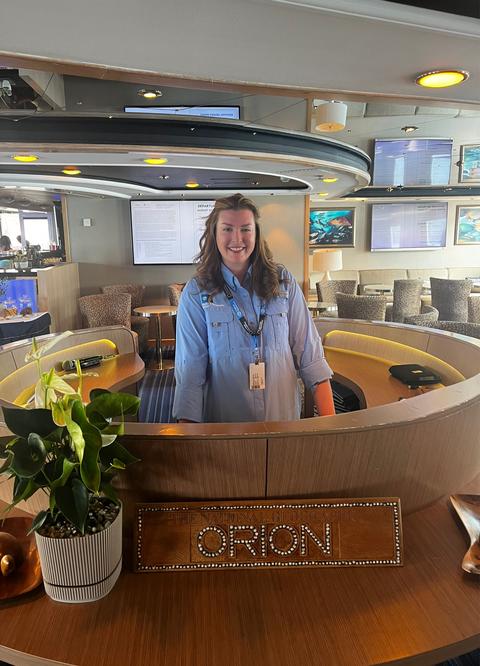
In August 2025, I left Canada to take part in the National Geographic Grosvenor Teacher Fellowship, a highly selective professional learning experience in partnership with Lindblad Expeditions. The fellowship brought myself and one other teacher from Minnesota aboard the National Geographic Orion. We explored Croatia and Montenegro alongside National Geographic experts, historians, scientists, photographers and local guides. Through guided walking tours, site visits, hikes and conversations with local experts and residents, I learned about the historical origins of Croatia and Montenegro, the impacts of conflict and post-war recovery, and the ways geography, culture and history shape identity and community belonging.
This experience has reshaped how I approach teaching history and place-based learning. Witnessing how communities in Croatia and Montenegro preserve, share and live their histories helped me better understand the power of local stories in shaping identity and belonging. I have brought this learning back to my classroom by shifting my focus from simply teaching historical events to helping students investigate the origins of their own community. My Grade 7 Humanities students are now working in partnership with the Chemainus Valley Historical Society to research local history and create a museum display. Through this work, students are learning to see history as something that lives within their own community, strengthening their sense of place, connection and responsibility to the stories they carry forward.
What's next for you?
For the past two years, I have worked as a Humanities, Science and English teacher in Grades 7 and 9. As I look ahead, I feel ready to take on a new challenge in my career. One possibility I am exploring is a return to the North, this time to teach in the Northwest Territories. Visiting and working in Canada’s northern territories has long been on my bucket list as an educator, and I am deeply drawn to the opportunity to learn from northern communities and contribute to place-based education in a new context.
Now that I have completed my master’s degree, I am also open to the possibility of moving into administration as a vice principal. I feel prepared to take on a leadership role that supports students, staff and school communities in meaningful ways. Whether my next step leads me north or into administration, I am grateful to the Cowichan Valley School District for being such a supportive and inspiring employer over the past 12 years, and I carry that experience forward as I consider what comes next.
Related Posts